


WoW Forever gold farming in launch week comes down to one rule: gather what crafters need before they can gather it themselves. World of Warcraft: Forever launched on November 4 with empty economies, and everyone levels a profession at once, so Herbalism, Mining and Skinning pay from level 1 with no investment. This guide splits how to make gold in WoW Forever into four level bands, names what sells in each and why, and links the guide that covers each method.
The targets are the mounts. In the live game’s data level 40 mounts cost 20 gold and level 60 mounts 200 gold, epic riding training at 60 costs 1,000 gold in the live game (checked November 6), the level 40 training price isn’t confirmed yet, and class training adds about 206 gold from 1 to 60 (Blizzard’s November 2 launch notes). Our planning numbers: 100 gold for riding at 40, about 1,500 gold in total by 60.
How solid this is: WoW Forever keeps Classic’s node spawns, mob spawns and quests in the original zones, so Classic’s farms hold. Prices and stack sizes come from the live client’s game data (build 1.60.1.70790, November 4). Auction prices in a game that opened on November 4 are unknown, so we name demand and the vendor price, the floor, instead of guessing.
How Much Gold You Need in WoW Forever
A WoW Forever character that trains every class ability and both riding skills and buys a level 60 mount needs roughly 1,500 gold from level 1 to 60: about 206 for class training, 1,000 for epic riding, 200 for the mount and our estimate of 100 for riding at 40.
| Cost | Price | How solid |
|---|---|---|
| Class training, levels 1 to 60 | About 206 gold in total for every class (Warlocks pay less, then buy pet Grimoires) | Blizzard, November 2 launch notes |
| Riding at level 40, first mount included | Unknown; plan 100 gold | Not published; 100 gold was Classic’s total |
| Extra level 40 mount from a vendor | 20 gold | Live game data |
| Riding at level 60 | 1,000 gold for the training | Checked in the live game, November 6 |
| Level 60 vendor mount | 200 gold | Live game data |
| Winterspring Frostsaber (Exalted) | 200 gold (1,000 in Classic Era) | Live game data |
| Profession ranks, Apprentice to Artisan | About 5 gold per profession | Our estimate from guide sites’ beta data |
| Expert books for Cooking, First Aid and Fishing | 1 gold each | Live game data |
| First talent reset | 1 gold | Player report on Blizzard’s forums, November 5 |
| Dual Specialization (level 40) | Unknown | Feature confirmed, price not |
| Flight paths | Classic fares; half with Frequent Flier | Live game data |
Two things to know. Bartering, the Legacy perk that takes 10% off vendor prices, stopped discounting training and repairs on October 16. And don’t buy a vendor mount before you train: the riding trainer hands you your first mount. Method’s October 21 guide listed 100 and 1,000 gold for riding without a source; at level 60 the live game charges 1,000 gold for the training alone, plus 200 gold for the mount. Our WoW Forever mount guide maps every riding trainer, and our level 40 mount tips cover saving without farming.
Best Professions for Gold in WoW Forever: Start With Gathering
Gathering professions make the most gold in WoW Forever’s first weeks, for three reasons in the game data:
- Crafters need more high-tier materials than in Classic. Forever’s Tailoring, Leatherworking and Blacksmithing recipes go grey 20 to 45 points earlier: a Tailor burns about 815 Mageweave (456 on a Classic route), a Leatherworker about 670 Rugged Leather (about 450).
- Nobody has a stockpile. Every crafter started on November 4.
- Scarce materials. Pyrite, Bauxite and Pitchblende from veins, Frilled Lichen, Rosecap and Stranglevine from herbs, Pristine Leather, Hide and Scale from skins: rare extras that feed the new rare gear and reagent bag dyes, and only gatherers find them.
Herbalism plus Mining is the safest pair; Mining plus Skinning suits classes that kill beasts all day. Our WoW Forever professions guide compares every pair. Crafting pays later: much new crafted leveling gear binds on pickup, and vendors pay less for crafted gear than in Classic (see below).
Making Gold From Level 1 to 20
From level 1 to 20, make gold in WoW Forever by gathering in the starting zones, selling low materials while crafters level, and spending nothing you don’t have to.
- Sell Peacebloom, Silverleaf and Copper early. An Alchemist uses about 92 Peacebloom to reach 225, and First Aid now makes healing potions from herbs. Copper has the most spawns of any ore, so its price should fall first (our read). Our WoW Forever herb farming guide and ore farming guide name the zones; the October 1 beta notes thinned out Poor Copper Veins in the starting valleys.
- Keep the Scarce drops. Pyrite becomes Sulfuric Acid for 30 Blacksmithing rare plans, Frilled Lichen becomes Cerulean Dye for 130 recipes including four reagent bags, Pristine Leather goes into 80 Leatherworking recipes. Vendors pay 1 silver, 30 copper and 1 silver 25 copper; what crafters pay is unknown as of November 5.
- Skin what you kill. Light Leather sells best in the first days, before every new skinner has a stack; Darkshore and the northern Barrens are the farms in our WoW Forever leather farming guide.
- Use Linen, don’t dump it. Tailors need less than half of Classic’s Linen. 40 Linen fill an Apprentice Textiles Waylaid Crate and First Aid eats about 150 (our WoW Forever cloth farming guide).
- Spend nothing extra. Skip auction house gear, learn only the spells you use and do the bag quests. Deviate Fish from the Barrens’ oasis ponds are the early money in our fishing gold guide.
Making Gold From Level 20 to 40: Saving for the Mount
Between level 20 and 40, WoW Forever gold comes from mid-level materials crafters need in bulk, from elementals in the late 30s, and from not spending your riding money.
- Silk Cloth. Tailors use about 512 Silk between skill 100 and 170 while most characters are below 30, and Silk barely drops from mobs below level 26. Expect it to stay short for the first two weeks after launch.
- Heavy and Thick Leather. Leatherworkers need them at character level 20 to 35, but Heavy drops from level 30 beasts and Thick from 40. Don’t vendor either.
- Iron Ore and mid herbs. One Blacksmith uses about 225 Iron; Goldthorn, Kingsblood and Stranglekelp, which grows only underwater, have steady buyers.
- Elementals around level 38. Arathi Highlands has all four kinds at about 10% drop chances in Classic data, and Forever’s First Aid now uses Elemental Water; see our low-level elemental farming guide.
- Quiet grinding. The Duskwood worgen around level 30 are on our list of hidden grinding spots. Humanoids at 35 to 37 earned 5 to 10 gold an hour in our 2019 Classic estimate.
- Craftsman’s Writs. Sealed Writs drop from enemies and become orders for one crafted item (Rough Bronze Leggings, Explosive Sheep, Mana Potions). They trade, so sell spares or craft for holders.
By level 40, keep 100 gold for riding on top of class training. Blizzard published only the 1 to 60 training total; if Forever spreads it like Classic, where higher ranks cost more, most of it falls due after 40 (our assumption).
Making Gold From Level 40 to 60
From level 40 to 60, the WoW Forever materials crafters run short of are Mageweave, Mithril and Thick Leather.
- Mageweave Cloth, the bottleneck of launch month. Tailors want it from skill 140 and Blacksmiths need 214, but it only drops in quantity from mobs level 41 up. The Dunemaul ogres in southern Tanaris drop about 0.70 per kill in Classic data.
- Mithril Ore. The biggest ore need before Artisan and our pick for best seller in weeks two and three. The Hinterlands have the most spawns (130 on Wowhead).
- Thick Leather and Purple Lotus. South-western Tanaris for Thick Leather; Purple Lotus gets Blacksmiths as buyers from level 40, since eight new pieces use it.
- Azshara. Legashi satyrs drop Felcloth and Runecloth, and Mooncloth, made from Felcloth, goes into 55 recipes against 32 in Classic. Our Azshara gold farming guide has the route.
- Smaller Mage AoE pulls. Blizzard capped Improved Blizzard’s slow at 40% instead of 65% to curb Frost Mages farming instances for gold (Mage and Shaman class article). Small pulls still work; see our Mage AoE farming guide.
Most players level from 35 to 45 in the new Riverglades zone, but its herbs, veins and beasts aren’t public yet.
Making Gold at Level 60
At level 60, WoW Forever gold comes from Runecloth, Rugged Leather, Thorium and the top herbs, and from the raid market that opens on December 9.
- Runecloth. A Tailor needs about 1,740 from skill 225 to 290. The Twilight camps in Silithus are the best open-world farm; the elites of Tyr’s Hand made an estimated 100 gold an hour in 2019 Classic. Vendors pay 80 silver a stack, so never post below that.
- Rugged Leather. About 670 per Leatherworker, best farmed in the northern Eastern Plaguelands; 1 gold a stack at any vendor. Leatherworkers can sell Cured Rugged Hide as a service (making gold with Leatherworking).
- Thorium and Winterspring. Winterspring has the most Rich Thorium (71 on Wowhead), but its elites’ epic quest items lost their Classic buyers; our Winterspring farming guide explains what still sells. The Crusader and Icy Chill formulas drop where they did (rare recipe drops).
- New level 60 materials. Heavy Thorium Ore, Death Lotus, Marefoil, Demonsage and Torbernite are in the live client with no published source as of November 5; Torbernite sells to vendors for 1 gold 50 silver each. The first farmers will set these prices.
- Trading. Our auction house gold guide shows how to buy materials cheap and craft what sells.
The raids open on December 9 (Blizzard’s raid overview). Until then there is little demand for flasks and protection potions, so Dreamfoil, Gromsblood and Black Lotus are worth holding for that week (our read).
What’s Different From Classic: WoW Forever’s Economy
Temporary Economy Holds and direct gold payments
On October 13, Kaivax announced Temporary Economy Holds: accounts suspected of buying or selling gold lose trade, mail, guild banks and the Auction House until Blizzard has investigated. Blizzard expects some false positives while the system is tuned, and a hold leaves no permanent mark unless gold buying is proven. On October 27 Blizzard added that gold for services must be paid directly: gold passed through a middleman can be removed. Sell carries or crafts only to the player who pays. No WoW Token is planned for Forever, Blizzard’s Clay Stone told Warcraft Tavern in September.
Crafted items sell for less at the vendor
The October 8 notes set Enchanting’s wands and oils to new, low vendor prices, and the October 16 notes cut “many items created by professions”. Comparing the live client with the October 13 beta build: 81 of 1,964 crafted items sell for less, a median 40% less. 53 are Blacksmithing gear; most others are Enchanting relics, Leatherworking armor and Engineering goggles. Smelted bars kept their prices except the new Heavy Thorium and Azerothium Bars, as did almost every cloth bolt, bag, potion and food. Wands weren’t cut again on October 16.
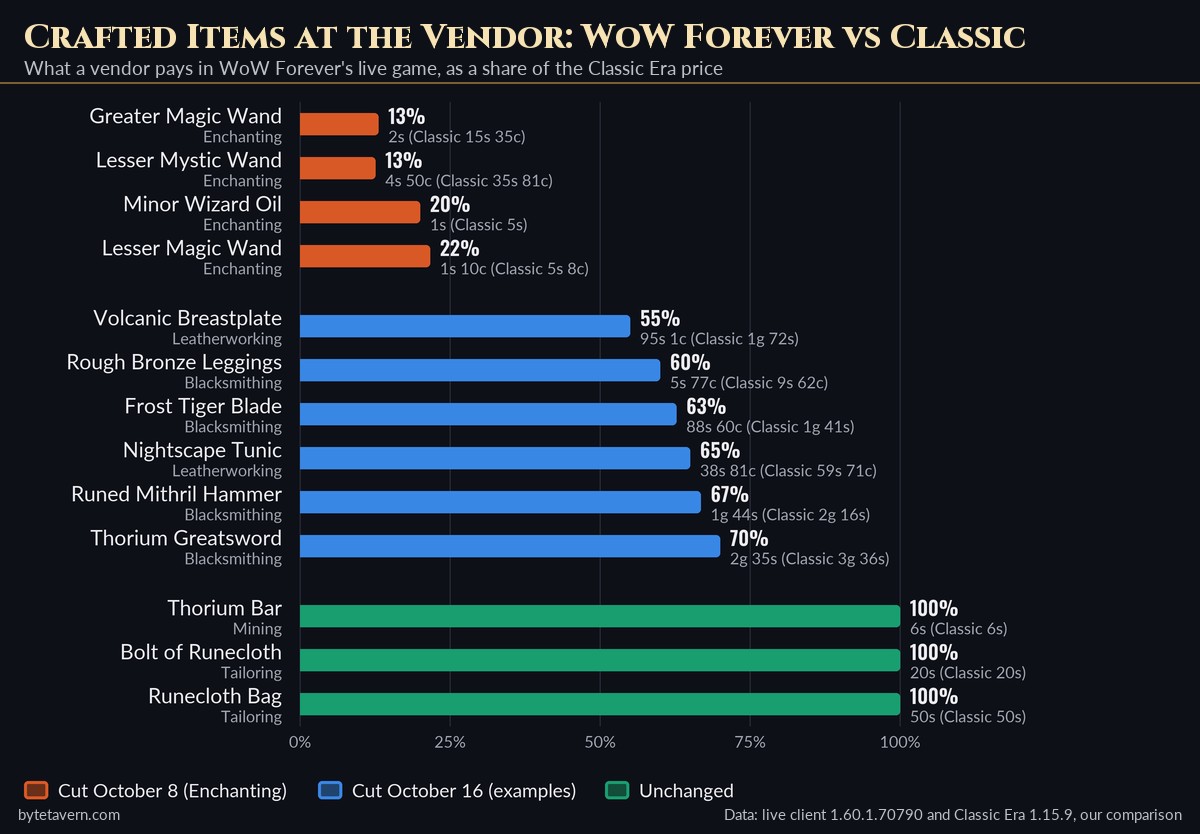
What it means: leveling Blacksmithing or Enchanting no longer pays part of its way at the vendor, so count crafting materials as a cost. Raw materials and bars lose nothing.
Merchant’s Favor and Craftsman’s Writs
Forever’s two profession systems pay in recipes and reputation, not gold. Waylaid Crates drop from enemies; filled with materials (40 Linen, 20 Copper Ore or 20 Peacebloom at the Apprentice rank), they pay 5 to 20 Merchant’s Favor at the Apprentice and Journeyman ranks at Three Corners in Redridge (Alliance) or west of the Crossroads (Horde), plus a few silver according to WoW-Professions. Favor buys about 300 recipes (Zockify’s counts); their gear mostly binds on pickup, their consumables sell. Craftsman’s Writs (150 in the live client) give 75 to 200 reputation per turn-in. For gold: crate your cheapest material, sell spare writs.
Auction House changes
The WoW Forever Auction House works like Classic’s, plus two October 16 additions: a column for the level needed to equip an item, and correct stats for suffix items such as “of the Monkey”. Stacks are bigger: ore, hides, meat, cloth bolts, elemental materials and many elixirs stack to 20 in the live client, against 10 (elixirs 5) in Classic Era. Auctionator has a Forever version (WoW Forever addons).
Faster launch respawns in low zones
Blizzard’s November 2 notes raised respawn rates for launch, fastest in the starting zones, and will turn the low zones back to “more typical rates” once the rush settles, with no date or zone list. Until then low herbs, veins and beasts refill faster than in Classic, so more Copper, Peacebloom and Light Leather reach the market: sell those early (our read).
Bountiful Harvest and other Legacy perks that save gold
A new account has no Legacy Points until its first Legacy Challenges, such as level 25 on a class or 150 in a crafting profession. First picks, both open from the start: Bountiful Harvest for gatherers (Scarce materials 20% more likely per rank, twice as likely at rank 5; normal yields don’t change) and Reinforce (40% less durability loss on death). Working Overtime (20% more skill-ups) saves materials. Bartering (10% off vendor items) needs 5 points in its tree; Frequent Flier (flights 50% cheaper) and Reagent Economy (no vendor reagents for class spells) need 10. Our WoW Forever Legacy System guide has every perk.
FAQ
What is the fastest way to make gold in WoW Forever?
Take two gathering professions at level 1 and sell to crafters who level at the same time. Nobody has measured gold per hour in WoW Forever yet.
What are the best professions to make gold in WoW Forever?
Herbalism and Mining, or Mining and Skinning. Forever’s crafters need more Mageweave, Runecloth and Rugged Leather than in Classic, and only gatherers find Scarce materials.
Which class is best for gold farming in WoW Forever?
No class has a measured edge yet. Blizzard weakened Frost Mage AoE kiting on purpose, and gathering income doesn’t depend on class.
Can you buy gold in WoW Forever?
Not legally. There is no WoW Token, and Blizzard’s Temporary Economy Holds lock trade, mail, guild banks and the Auction House on accounts suspected of buying or selling gold.
Leveling, dungeons and every other launch guide: our WoW Forever hub.
Sources: Blizzard’s development notes (October 8 and 16, November 2 launch notes), Kaivax’s posts on Temporary Economy Holds and direct gold transactions, Blizzard’s raid overview and Mage and Shaman article. Prices, stack sizes and recipe uses from the live client (1.60.1.70790) and Classic Era (1.15.9) via wago.tools, our comparison; crate and writ details from Zockify and WoW-Professions; spawn and drop data from our farming guides. Key art: Blizzard Entertainment.